TL;DR:
- Always check for gas leaks and safety hazards before attempting to reset a boiler.
- Resetting most boilers involves turning off, holding the reset button, and waiting for restart.
- Repeated resets indicate underlying faults requiring professional inspection to prevent damage or safety risks.
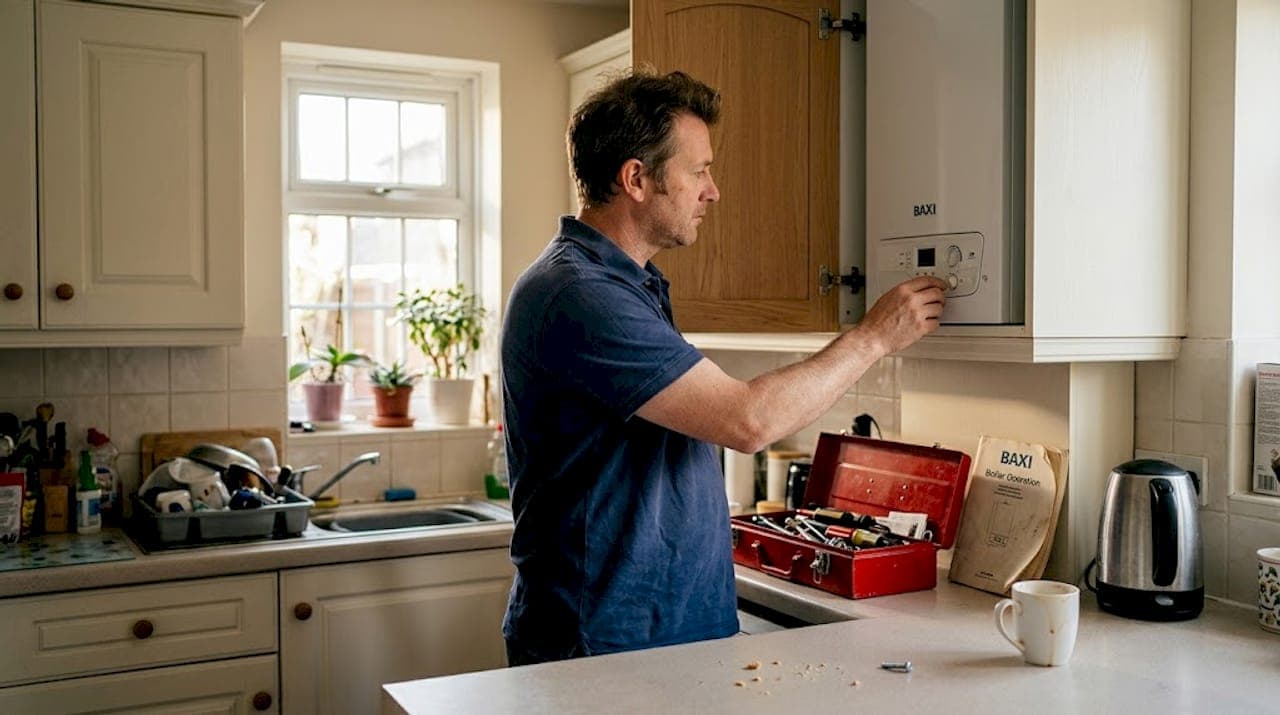
It's a cold morning in Reading, Oxford, or Newbury, and your boiler has gone quiet. No heat, no hot water, and a flashing light you don't recognise. Before you pick up the phone, it's worth knowing that a simple reset is often all it takes to get things running again. This guide walks you through every stage safely: from checking for danger signs, to pressing the reset button correctly, to knowing when a fault is beyond a quick fix. Follow each step carefully, and you'll either restore your heating yourself or be well prepared to explain the problem to an engineer.
Table of Contents
- Before you start: safety, tools, and preparation
- How to reset a boiler: step-by-step instructions
- Troubleshooting: what to check if the reset doesn't work
- How to reduce future boiler resets
- The truth about DIY boiler resets in Thames Valley homes
- Need help? Fast expert boiler repairs are just a call away
- Frequently asked questions
Key Takeaways
| Point | Details |
|---|---|
| Safety first | Always check for warning signs and never reset if you suspect a gas leak. |
| Follow precise steps | Use the correct reset procedure from your manual to avoid damaging your boiler. |
| Limit resets | Never repeatedly reset a faulty boiler; frequent issues need a professional. |
| Maintain proactively | Regular servicing reduces breakdowns and keeps your system running smoothly. |
Before you start: safety, tools, and preparation
Now that you're ready to tackle the issue, start by making sure it's safe and you have what you need. This step matters more than the reset itself. Rushing straight to the button without checking a few basics first can turn a minor nuisance into a serious hazard.
The most important check is for gas. If you smell anything like rotten eggs or sulphur near the boiler, do not touch any switches. Leave the property, keep doors open as you go, and call the National Gas Emergency Service on 0800 111 999. A boiler reset is never worth the risk of ignoring a potential gas leak. Boiler breakdowns can resolve common faults, but always check for gas leaks and refer to the manual first.
What to check before you do anything else:
- Is there a smell of gas? Stop immediately and evacuate.
- Are there visible water leaks around the boiler or pipes?
- Is the pressure gauge reading below 1 bar or above 3 bar?
- Are any warning lights flashing? Note down what they say.
- Is the boiler display showing an error code? Photograph it.
Tools and items to have ready:
- Your boiler manual (often stored in the boiler cupboard or downloadable from the manufacturer's website)
- A torch if the boiler is in a dark cupboard or utility room
- Your mobile phone, in case you need to call for help
| Check or item | Why it matters |
|---|---|
| Gas smell check | Prevents risk of explosion or carbon monoxide exposure |
| Pressure gauge reading | Low or high pressure is a common reset blocker |
| Error code or warning light | Tells you and your engineer what triggered the lockout |
| Boiler manual | Gives model-specific reset instructions |
| Torch | Helps you see controls clearly in tight spaces |
| Mobile phone | Allows you to call for help without leaving the area |
If there are visible leaks, persistent warning lights, or anything that doesn't feel right, step back. The boiler breakdown essentials covered in specialist guidance are there for a reason: some faults genuinely need a Gas Safe registered engineer.
"When in doubt, don't. A quick phone call to a professional costs far less than ignoring a warning sign."
Pro Tip: Before touching the reset button, take a clear photo of the boiler display. If the fault persists or you need to call an engineer, that image can save considerable time diagnosing the problem.
How to reset a boiler: step-by-step instructions
With safety in mind and tools ready, you can proceed to the reset process itself. The good news is that resetting most modern boilers is straightforward. The challenge is that reset button locations differ by model, so your manual is your best starting point.
Common reset button locations by brand:
| Brand | Typical reset button location |
|---|---|
| Worcester Bosch | Front panel, often marked with a flame symbol |
| Vaillant | Front control panel, below the display screen |
| Ideal | Right side of the front fascia |
| Baxi | Lower front panel or behind a flip-down cover |
| Viessmann | Touchscreen or dedicated button on the front display |
Not all models follow this exactly, so cross-reference with your manual before assuming.
Step-by-step reset instructions:
- Turn off the boiler using the power switch or thermostat. Give it a full 30 seconds before proceeding.
- Check the pressure gauge. It should sit between 1 and 1.5 bar. If it's too low, top it up via the filling loop before resetting.
- Locate the reset button on your boiler using the manual or the table above.
- Press and hold the reset button for around 3 to 10 seconds, depending on your model. Some require a brief press; others need a longer hold.
- Release the button and wait. The boiler may click, hum, or cycle through a startup sequence. This is normal.
- Watch the display for any new error codes or warning lights. If the display clears and the boiler fires up, you've succeeded.
- Check your radiators and hot water taps within five minutes to confirm normal operation has resumed.
What you'll hear and see during a successful reset is reassuring: a soft ignition click, a low hum as the burner fires, and the pressure gauge holding steady. If the boiler fires but then locks out again within minutes, there's an underlying fault rather than a simple glitch.
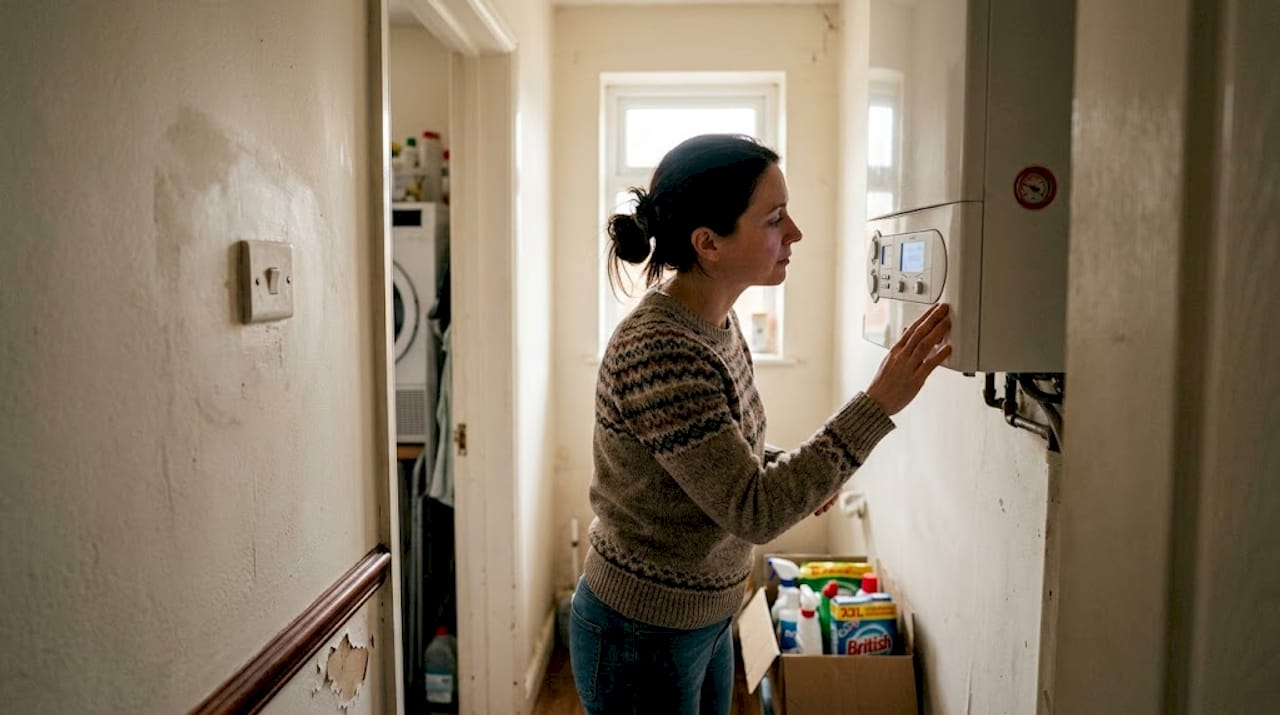
Pro Tip: If the heating doesn't restart within five minutes of the reset, wait at least ten minutes before trying again. Repeated immediate resets can stress components and may void your warranty.
Troubleshooting: what to check if the reset doesn't work
If your boiler doesn't return to normal operation, some quick checks can save you time and inform your next steps. A failed reset isn't necessarily a disaster. In many cases, there's a straightforward reason why the boiler locked out again, and you can identify it without touching any internal components.
The three most common reasons a reset fails:
- Low boiler pressure. If the gauge is below 1 bar, the boiler won't stay running even after a reset. Repressurising via the filling loop often solves it immediately.
- An active fault code. Some error codes indicate a persistent fault that a reset cannot clear on its own. The code will return until the root cause is fixed.
- Frozen condensate pipe. In cold winters across Thames Valley, the plastic pipe carrying waste water away from a condensing boiler can freeze solid. This triggers a lockout that a reset alone won't fix until the pipe is thawed safely.
What to check before calling an engineer:
- Pressure gauge: is it reading between 1 and 1.5 bar?
- External power: has the boiler lost power due to a tripped fuse or circuit breaker?
- Thermostat settings: is the thermostat set high enough to actually call for heat?
- Condensate pipe: is there any ice visible on the external pipe during cold weather?
- Error lights: are the same codes appearing as before the reset?
Knowing these boiler fault warning signs helps you give an accurate description when you do call for help. Persistent boiler faults might mean a deeper issue requiring a qualified engineer, and trying to force a fix by resetting repeatedly can make things worse.
Never attempt to open the boiler casing. Always leave internal problems to a Gas Safe registered engineer.
For extra reassurance on what's safe to check yourself, the boiler service safety tips available from specialist resources are worth a read before you decide on your next move.
Pro Tip: Write down or photograph every error code you see, including the sequence in which they appeared. Engineers can diagnose faults far more quickly when they have a precise record rather than a vague description.
How to reduce future boiler resets
Even if your reset works, prevention is the best long-term strategy for safe, reliable heating. A boiler that needs resetting once every few years is normal. One that locks out repeatedly is signalling that something isn't right, and the fix is almost always far cheaper when caught early.
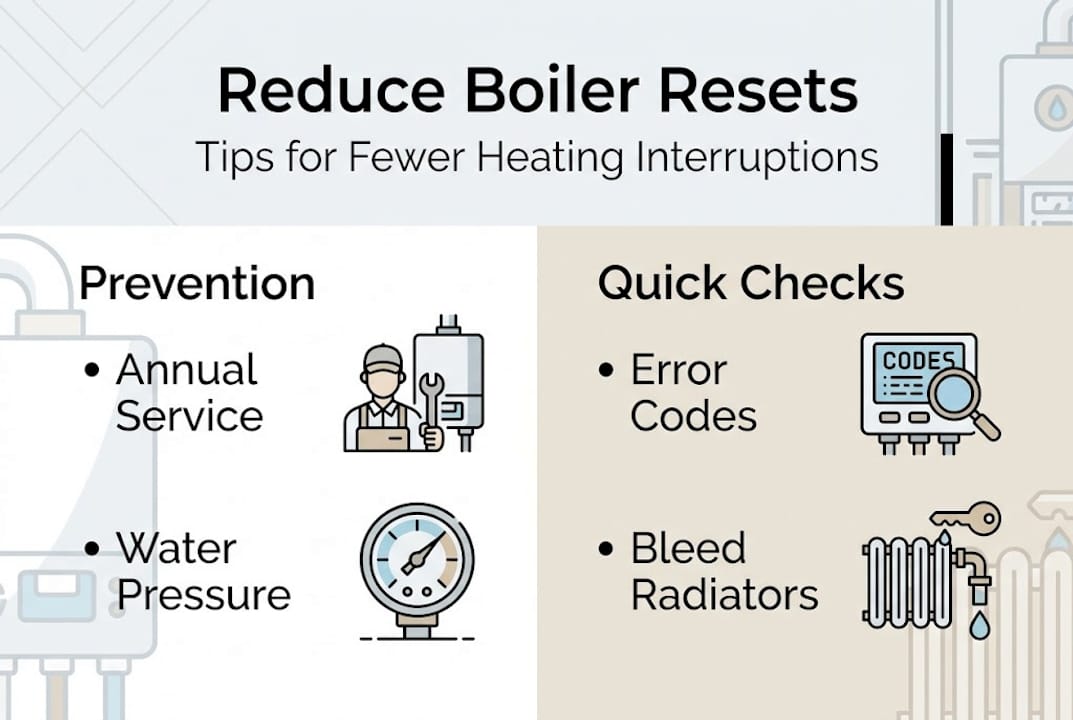
The single most effective thing you can do is book an annual service with a Gas Safe registered engineer. A yearly check typically takes around an hour and covers combustion efficiency, heat exchanger condition, flue integrity, and safety controls. Regular servicing can dramatically decrease system faults and emergencies, which translates directly into fewer cold mornings and lower repair bills over time.
Between services, there are several simple habits that make a meaningful difference:
- Check the pressure monthly. A gauge reading between 1 and 1.5 bar is ideal. Top it up via the filling loop if it drops below 1 bar.
- Bleed your radiators once a year, ideally before winter. Trapped air reduces efficiency and puts unnecessary strain on the boiler.
- Keep air vents and flue outlets clear. Leaves, nests, and debris can block ventilation and trigger safety lockouts.
- Listen for unusual sounds. Banging, kettling, or whistling from the boiler or pipes often means scale build-up or a circulation issue worth catching early.
- Keep the boiler area dry and ventilated. Moisture around the unit accelerates corrosion.
- Note your last service date and set a reminder. Most manufacturers recommend annual servicing to keep warranties valid.
Using a maintenance checklist tailored to your system type can help you stay on top of these tasks without relying on memory alone. A well-maintained boiler doesn't just break down less often; it also runs more efficiently, which typically shows on your energy bills.
The truth about DIY boiler resets in Thames Valley homes
Most online guides make resetting a boiler sound like a foolproof, five-minute task. And often it is. But there's something many of those guides don't say plainly enough: a reset is a diagnostic shortcut, not a solution.
When a boiler locks out, it's protecting itself and your home from a fault it has detected. Pressing the reset clears the alert and tries again. If the fault was a temporary glitch, that's fine. But if the same underlying problem is still present, the boiler will lock out again, sometimes faster the second time.
We've seen homeowners reset the same boiler six or seven times over a weekend, hoping it will eventually "take." It rarely does. Worse, some faults require immediate attention for safety reasons, and repeated resets can delay that call while the problem worsens. Certain error conditions, particularly those involving ignition failures or flame detection, should prompt a professional visit after a single failed reset, not several more attempts.
Another thing guides often skip: repeated lockouts can void some manufacturer warranties. Always check your warranty terms before running multiple resets. Our honest advice, built from years of emergency heating repair work across Thames Valley, is this: reset once, document everything, and if it locks out again, call someone who can actually fix the cause.
Need help? Fast expert boiler repairs are just a call away
If you'd rather let a professional restore your heat, help is nearby. Sometimes a reset just isn't enough, and there's no shame in calling in the experts. That's exactly what we're here for.

At 999Plumber.co.uk, our Gas Safe engineers cover the whole Thames Valley region, 24 hours a day, seven days a week. Whether you need Newbury boiler repairs or urgent help anywhere across the region, we offer no call-out charges and a no fix, no fee guarantee. You can book an emergency plumber online in minutes, or browse our full range of central heating repairs to find exactly the help you need. No fuss. No waiting around. Just fast, reliable service from engineers who know Thames Valley homes inside out.
Frequently asked questions
Is it safe to reset my own boiler?
Yes, if there are no signs of a gas leak or visible damage, a reset is generally safe for a homeowner to attempt. Always stop immediately if you notice a warning light that won't clear or smell anything unusual, and refer to your boiler breakdown guide for model-specific advice.
Where is the reset button on most boilers?
The reset button is usually found on the front control panel, but its exact position varies between manufacturers and models. Always check your boiler manual first, as reset locations differ significantly across brands like Worcester Bosch, Vaillant, and Baxi.
How many times can I safely reset my boiler?
Once or twice is a reasonable limit. If the boiler locks out again after two attempts, there is likely a recurring fault that needs a Gas Safe engineer, not another reset. Persistent faults almost always require professional diagnosis.
What should I do if my boiler keeps locking out?
Stop resetting it and contact a Gas Safe registered engineer. Frequent lockouts are a sign of a recurring fault that a reset cannot fix, and continuing to override the safety mechanism can worsen the problem. Recurring boiler lockouts are a clear signal to call a professional.