TL;DR:
- Regular plumbing inspections detect issues early, saving money and preventing damage.
- Inspections involve comprehensive assessments including visual checks, pressure tests, CCTV surveys, and thermal imaging.
- Frequent inspections are vital for older homes and those in flood-prone Thames Valley areas to ensure safety and compliance.
Most homeowners only think about their plumbing when something goes wrong. A pipe bursts, a radiator stops working, or the boiler packs in at midnight in January. By that point, the damage is done and the bill is already mounting. The truth is, regular plumbing inspections catch problems long before they reach crisis point, keeping your home safe, your system compliant with UK regulations, and your wallet considerably better off. For homeowners across the Thames Valley, understanding the role of these inspections is one of the smartest steps you can take to protect your property and the people living in it.
Table of Contents
- Why plumbing inspections matter for Thames Valley homes
- What does a plumbing inspection involve?
- When and how often should you have your plumbing inspected?
- Signs you need a plumbing inspection soon
- Why proactive inspections beat reactive repairs every time
- Local experts for your inspection and repairs
- Frequently asked questions
Key Takeaways
| Point | Details |
|---|---|
| Routine inspections protect homes | Regular checks prevent hidden issues, costly repairs, and support Thames Valley property values. |
| Compliance ensures safety | Certified inspections verify your plumbing meets current UK regulations, protecting residents and insurance. |
| Proactivity beats emergency fixes | Inspections are more affordable and effective than waiting for breakdowns or floods to occur. |
| Local experts add value | Experienced Thames Valley plumbers know the region’s systems and standards, ensuring reliable results. |
Why plumbing inspections matter for Thames Valley homes
Having previewed the protective role of plumbing inspections, let's explore why these checks matter so much for homes in the Thames Valley.
The Thames Valley is home to a diverse mix of property types, from Georgian townhouses in Reading to modern new-builds in Didcot and older semi-detached homes across Oxfordshire. Each of these property types brings its own plumbing quirks, and many carry hidden risks that only a trained eye can spot. Older homes are particularly vulnerable to corroded pipework, outdated drainage systems, and water pressure irregularities caused by years of wear.
Here is what a proper plumbing inspection can do for you:
- Catch silent leaks before they rot floorboards, damage insulation, or cause mould growth
- Verify correct drainage to prevent blockages and sewage backing up into the home
- Check boiler and heating system integrity to confirm safe, efficient operation
- Confirm material compliance so you are not unknowingly using substandard fittings
- Assess water pressure to identify stress points that could cause pipe failure
Inspections verify compliance with UK Building Regulations Parts G (sanitation and hot water), H (drainage), and Water Supply Regulations via WRAS-approved materials. This matters because non-compliant plumbing can invalidate your home insurance, complicate property sales, and in serious cases, pose a genuine health and safety risk.
"Skipping routine plumbing inspections is a bit like skipping your car's annual MOT. The car may feel fine right up to the point it does not."
Pro Tip: If your home was built before 1980, schedule an inspection every 12 to 18 months rather than waiting for visible problems. Older pipework degrades silently and is far more likely to fail without warning.
The cost argument is equally compelling. A routine inspection typically costs a fraction of what you would pay for burst pipe remediation, which can run into thousands once you factor in water damage, flooring, and replastering. Our plumbing surveys guide covers the financial case in more detail, but the short version is simple: prevention is dramatically cheaper than cure.
What does a plumbing inspection involve?
Now that you know why inspections are crucial, here's what actually happens when your home's plumbing is professionally checked.
Many homeowners imagine a plumber poking around under the sink for ten minutes. The reality is far more thorough. A professional inspection is a systematic assessment of your entire water system, from the incoming supply to every drain, radiator, and appliance connected to it.
Here is a step-by-step breakdown of what a proper inspection covers:
- Visual assessment of all accessible pipes, joints, fittings, and appliances for visible corrosion, scaling, or damage
- Pressure testing to identify weak points in the system where failure could occur under normal operational conditions
- Flow testing to confirm adequate water delivery to all outlets and detect partial blockages
- Drainage checks to verify that waste water exits correctly and that there are no slow-draining areas that could indicate blockages further down the system
- CCTV drain survey for a detailed internal look at underground or concealed drainage runs where visual inspection is not possible
- Thermal imaging to detect hidden leaks behind walls, under floors, or within ceilings without invasive work
- Gas and electrical integration checks to confirm that any combined systems, such as combination boilers or heated towel rails, are safely connected and operating within required parameters
Methodologies include visual assessments, operational testing (pressure, flow, drainage), CCTV drain surveys, thermal imaging for leaks, and safety checks for gas and electrical integration. This range of tools is what separates a professional inspection from a simple visual check.
| Inspection method | What it finds | Invasive? |
|---|---|---|
| Visual assessment | Surface corrosion, visible leaks, joint wear | No |
| Pressure test | Pipe weakness, micro-leaks | No |
| CCTV drain survey | Blockages, cracks, root intrusion | No |
| Thermal imaging | Hidden leaks, cold spots, insulation gaps | No |
| Drainage flow test | Slow drains, partial blockages | No |
Common findings in Thames Valley homes include limescale build-up in areas with hard water (a real issue across much of Berkshire and Oxfordshire), corroded copper pipework in properties built in the 1960s and 70s, and cracked clay drainage pipes in older terraces. Knowing how to spot plumbing leaks early can save you considerable money, and when leaks are found behind surfaces, trace and access repairs are carried out with minimal disruption to your property.
When and how often should you have your plumbing inspected?
Understanding the inspection process is vital, but knowing when and how often these checks are needed is just as important.
There is no single answer that fits every household, but there are clear guidelines based on property age, usage, and whether you rent the property out or live in it yourself.
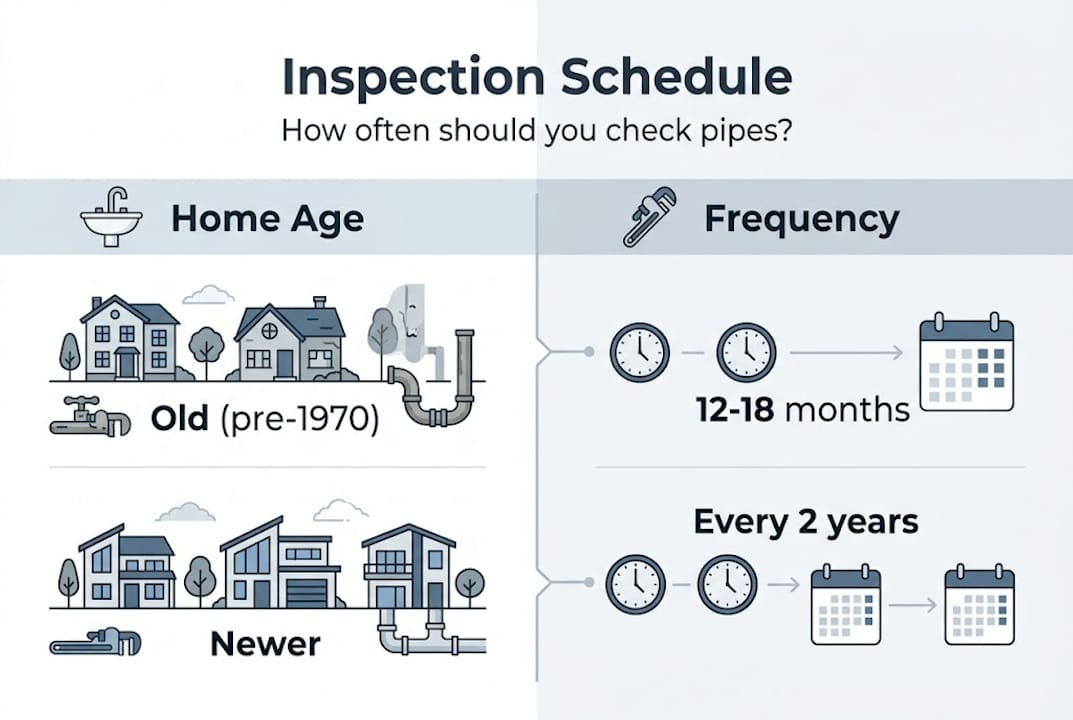
| Property type | Recommended inspection frequency |
|---|---|
| Boiler and gas appliances (rental) | Annually, legally required |
| Boiler and gas appliances (owner-occupied) | Annually recommended |
| Pipes in homes built before 1980 | Every 12 to 18 months |
| Pipes in homes built after 1990 | Every 2 to 3 years |
| Pre-purchase survey | Before any property purchase |
| Drainage and sewer checks | Every 2 years for older properties |
Annual inspections for boilers and gas safety are mandatory for rental properties, and every 1 to 2 years for pipes in older homes. Pre-purchase surveys are considered essential before completing any property transaction.
For landlords in the Thames Valley, there is no wiggle room on gas safety. You must have a valid Gas Safety Certificate in place at all times. Missing this is not only a legal breach but can expose you to serious liability if a tenant is harmed. Review our gas safety compliance guidance for a full rundown of your responsibilities.
For owner-occupiers, here are the key moments to book an inspection:
- Before purchasing a property, to avoid inheriting expensive problems with no recourse
- After major renovation or extension work, to confirm new pipework is correctly installed and connected
- When a property has been empty for more than six months, because static water systems can develop significant issues including Legionella risk and seized valves
- After a particularly cold winter, when freeze-thaw cycles may have stressed pipework or caused micro-cracks that are not yet leaking but will be soon
- Every year for your boiler, as part of a regular boiler maintenance routine
Did you know that a single undetected slow leak can waste over 60,000 litres of water per year? That is not just an environmental concern. In areas where Thames Water metering is in place, that figure translates directly onto your bill.
The age of your home matters enormously. Properties built before 1970 often still have original lead or iron pipework in sections, and this can pose serious contamination risks. A boiler service might seem like a small annual task, but when combined with a full system inspection, it builds a clear picture of your home's overall plumbing health year on year.
Signs you need a plumbing inspection soon
Knowing the inspection schedule is useful, but recognising urgent signals can save your home from greater damage.
Sometimes you cannot wait for the next scheduled inspection. Your home will often give you clear warnings that something is wrong, and ignoring those signals is where the real damage begins. Here are the most important triggers to watch for:
- Damp patches on walls or ceilings that appear without an obvious cause, particularly in rooms above bathrooms or near soil stacks
- Low water pressure at taps or showers that has developed gradually over weeks or months
- Unusual noises from pipes, such as banging when taps are turned off (known as water hammer), gurgling from drains, or whistling from the boiler
- Slow-draining sinks, baths, or basins throughout the house, not just a single outlet
- Unexplained spikes in your water or gas bill, which can indicate a hidden leak or a boiler working far harder than it should
- Visible discolouration or rust in tap water, which suggests pipe corrosion within your system
- Persistent damp or musty smells, especially in ground-floor rooms or under kitchen units
- Cracks in external drain covers or pooling water near the house that could indicate a collapsed drain run
Pro Tip: If you notice more than two of these signs at once, do not book a standard service call. Request a full plumbing inspection so that all related issues are identified together rather than discovered one at a time over several expensive visits.
Any of these signs in a property you have just purchased, or in a home that has recently undergone building work, should be treated with particular urgency. Our guide on emergency plumbing steps walks you through what to do if you suspect an active problem, while our boiler breakdowns guide explains how to read the warning signs specific to heating systems.
The Thames Valley's chalk geology and chalk stream catchments mean that groundwater movement is active across much of the region. Properties near rivers, flood plains, or areas with high water tables, including parts of Windsor, Marlow, and Abingdon, may experience ground movement that stresses underground drainage. This is a very local factor that a Thames Valley-based inspector will understand in a way that a national service simply might not.
Why proactive inspections beat reactive repairs every time
Having covered key triggers, let us explore why a proactive approach is the smartest move for Thames Valley homeowners.
In our experience, there is a consistent pattern that plays out with homeowners who call us in a panic. The problem has been building for months, sometimes years. The signs were there. A damp patch that appeared last autumn, a boiler that started running longer to reach temperature, a slow drain in the downstairs toilet. Each was noted, then quietly ignored in the hope it would resolve itself.
It never does.
Reactive repairs are almost always more expensive. Not just because the damage is worse by the time work starts, but because emergency call-outs cost more, access to hidden pipework costs more, and dealing with secondary damage (wet plasterwork, rotten joists, failed insulation) costs far more. We have seen Thames Valley homeowners pay four to five times more to fix a burst pipe in an uninsulated loft than they would have paid for three years of annual inspections.
There is also an insurance dimension that many homeowners overlook entirely. Most home insurance policies require that you take reasonable steps to maintain your property. If you make a claim for water damage and the insurer finds evidence of a long-standing leak that a routine inspection would have caught, your claim can be rejected. Proactive maintenance is not just good practice. It is often a contractual obligation.
Regular boiler servicing is the clearest example of this principle in action. A well-maintained boiler lasts significantly longer, operates more efficiently, and is far less likely to fail on the coldest night of the year. The same logic applies across your entire plumbing system. Treat it well consistently, and it will rarely let you down dramatically.
Local experts for your inspection and repairs
If you are ready to protect your home and avoid last-minute emergencies, here is how local experts can help.
At 999Plumber.co.uk, we work with Thames Valley homeowners every day, carrying out inspections, diagnosing hidden problems, and completing repairs without the drama. We operate 24 hours a day, seven days a week, with no call-out charges and a no fix, no fee guarantee that means you are never paying for guesswork.

Whether you need routine central heating repairs, a boiler inspection or repair, or an urgent fault investigated today, our experienced local engineers are ready to help. We understand Thames Valley properties, local water conditions, and the specific compliance requirements that apply in this region. Booking is straightforward, and our team will talk you through exactly what needs doing, with no unnecessary upsells. For urgent situations, our emergency plumbing and heating service can have an engineer at your door within the hour.
Frequently asked questions
Are plumbing inspections required for Thames Valley property sales?
Pre-purchase surveys are strongly recommended and are increasingly treated as essential due diligence before completing any property sale, helping buyers avoid inheriting costly hidden defects.
Which plumbing issues are most commonly found during inspections?
Inspectors frequently discover leaks, corrosion, faulty valves, and pressure issues, especially in older properties. Methodologies including CCTV surveys and thermal imaging help uncover problems that a basic visual check would completely miss.
Who should perform plumbing inspections in the Thames Valley?
Always use a qualified, locally experienced plumber who understands UK regulations and Thames Valley systems. Compliance with UK Building Regulations Parts G and H requires specific knowledge that only a properly trained engineer will have.
What happens if plumbing inspections reveal non-compliance issues?
You may need urgent repairs or upgrades to bring your system up to current standards. UK Building Regulations compliance is not optional, and non-compliant systems can affect your insurance cover, property sale, and the safety of everyone living in the home.